

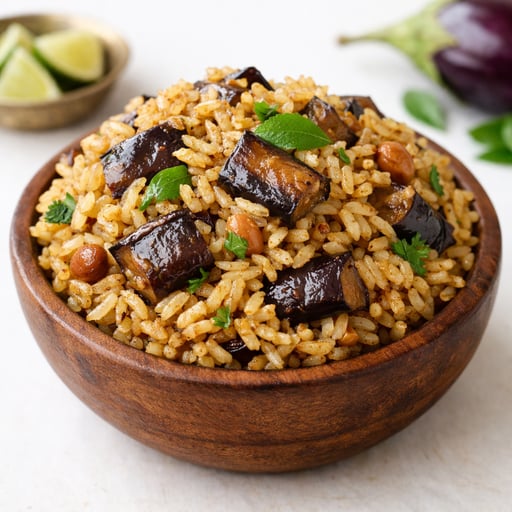
Eggplant/Brinjal riceMed
Also known as: VANGI BHAT
A flavorful Indian rice dish cooked with eggplant (brinjal) and spices, popular in home cooking and served as a main meal.
Nutrition per 100g
Nutrient Breakdown
Key Nutrients(14)
% DV = % Daily Value (adult RDA, ICMR 2020). Values per 100g edible portion.
Use Eggplant/Brinjal rice in meal plans
17,000+ foods with real-time nutrient tracking, AI generation, and WhatsApp sharing.
Start FreeFree plan · No credit card
Common questions about Eggplant/Brinjal rice
How many calories are in 1 plate of Eggplant/Brinjal rice?
1 plate (291 g) of Eggplant/Brinjal rice has about 538 kcal, based on 185 kcal per 100 g.
How much protein is in Eggplant/Brinjal rice?
Eggplant/Brinjal rice provides about 5.3 g of protein per 100 g.
How much sugar does Eggplant/Brinjal rice contain?
Eggplant/Brinjal rice has about 4.4 g of total sugars per 100 g.
Is Eggplant/Brinjal Rice a vegetarian dish?
Yes, it is a vegetarian dish made with rice, eggplant, and spices, containing no meat, eggs, or dairy.
What are common ingredients used to prepare Eggplant/Brinjal Rice?
Common ingredients include cooked rice, eggplant (brinjal), oil, onions, tomatoes, and Indian spices.
How should I store Eggplant/Brinjal Rice?
Store in a sealed container in the refrigerator and consume within 1-2 days for best quality.
About Eggplant/Brinjal rice
Eggplant/Brinjal Rice is a traditional Indian dish combining cooked rice with sautéed eggplant and aromatic spices. It’s commonly made at home with moderate use of oil and fresh ingredients, offering a wholesome vegetarian meal option. This dish provides significant amounts of copper, thanks to the eggplant content, which is an essential trace mineral in the diet.
- Contains significant copper (27% Daily Value per 100g)
- Prepared with cooked rice and vegetables
- Vegetarian and suitable for most diets
- Typically moderate in calories with balanced macronutrients
This dish is usually served hot as a main course for lunch or dinner and pairs well with yogurt or salad.
Values per 100g edible portion.
Nutrition data is for reference only. Values may vary by preparation method, brand, and region. Full disclaimer
Contains data from Indian Nutrient Databank (INDB), University of Edinburgh, licensed under CC BY 4.0, modified for presentation.
Report a data issueSimilar foods
Browse all →
Stuffed brinjal
Brinjal bhartha
Brinjal-1
Baingan
Brinjal-3
Baingan
Brinjal-20
Baingan
Brinjal-5
Baingan
Brinjal-6
Baingan
Brinjal-10
Baingan