

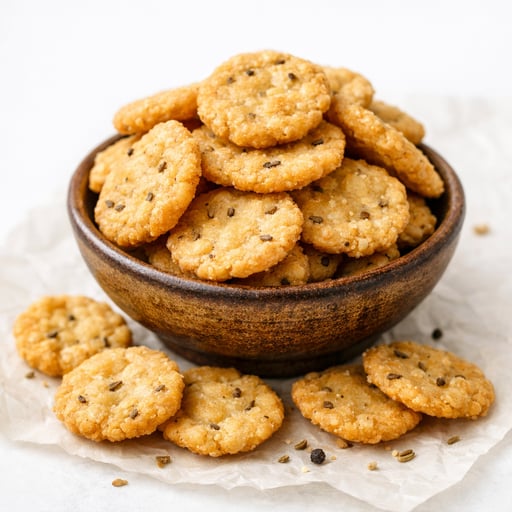
Mathri
मठरी
Mathri is a traditional North Indian deep-fried snack made from wheat flour and spices, popular for its crispiness and savory flavor. It is commonly enjoyed as an evening snack or during festivals.
Nutrition per 100g
Nutrient Breakdown
Key Nutrients(13)
% DV = % Daily Value (adult RDA, ICMR 2020). Values per 100g edible portion.
Use Mathri in meal plans
17,000+ foods with real-time nutrient tracking, AI generation, and WhatsApp sharing.
Start FreeFree plan · No credit card
Common questions about Mathri
How many calories are in 1 kachori of Mathri?
1 kachori (87 g) of Mathri has about 700 kcal, based on 805 kcal per 100 g.
How much protein is in Mathri?
Mathri provides about 1.7 g of protein per 100 g.
How much sugar does Mathri contain?
Mathri has about 0.3 g of total sugars per 100 g.
What is Mathri commonly eaten with?
Mathri is commonly eaten as a tea-time snack or with pickles and chutneys during festivals.
Is Mathri suitable for vegetarians?
Yes, Mathri is a vegetarian snack made from wheat flour and oil without any meat or eggs.
How should Mathri be stored?
Store Mathri in an airtight container at room temperature to keep it crisp for several days.
About Mathri
Mathri is a crunchy, flaky snack originating from North India, especially enjoyed in Rajasthan, Punjab, and Haryana. It is traditionally made by kneading wheat flour with ghee or oil and spices, shaped into discs, and deep-fried until golden and crisp. Mathri is often consumed with pickles, chutneys, or tea, making it a popular savory treat. The snack is fairly energy-dense due to its oil content and provides moderate protein and carbohydrate levels. Sodium content can be significant due to added salt, which is important to consider for sodium-sensitive individuals. Mathri does not contain vitamin B12 or vitamin C and is vegetarian. Common allergens include gluten from wheat flour. It fits well as a snack or teatime accompaniment, contributing to calorie intake and providing some dietary fiber but should be consumed in moderation as part of a balanced diet.
Values per 100g edible portion.
Nutrition data is for reference only. Values may vary by preparation method, brand, and region. Full disclaimer
Contains data from Indian Nutrient Databank (INDB), University of Edinburgh, licensed under CC BY 4.0, modified for presentation.
Report a data issueSimilar foods
Browse all →
Papdi
पापड़ी
Dhokla
ढोकला
Pearl millet mathri
Snacks, taro chips
Khakhra
Khaman
Sev
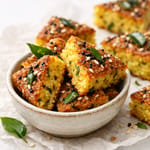
Gujarati handvo
गुजराती हैंडवो