

 by Workfile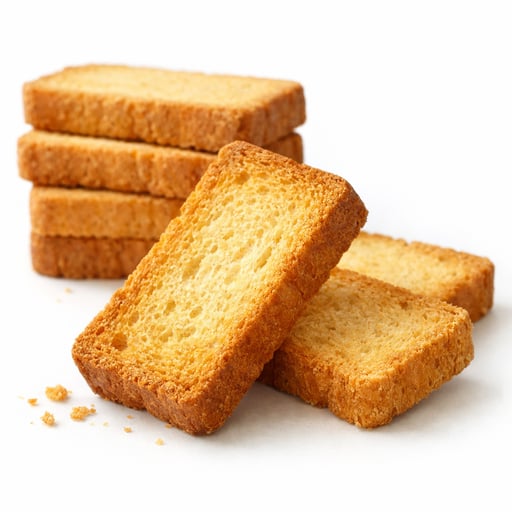
Crackers, rusk toast
क्रैकर्स रस्क टोस्ट
Crackers and rusk toasts are crunchy baked snack products commonly eaten with tea. They are made from wheat flour and have a crisp texture, often enjoyed as a light snack or breakfast accompaniment.
Nutrition per 100g
Nutrient Breakdown
Key Nutrients(18)
% DV = % Daily Value (adult RDA, ICMR 2020). Values per 100g edible portion.
Use Crackers, rusk toast in meal plans
17,000+ foods with real-time nutrient tracking, AI generation, and WhatsApp sharing.
Start FreeFree plan · No credit card
Common questions about Crackers, rusk toast
How many calories are in oz of Crackers, rusk toast?
oz (14 g) of Crackers, rusk toast has about 58 kcal, based on 407 kcal per 100 g.
How much protein is in Crackers, rusk toast?
Crackers, rusk toast provides about 13.5 g of protein per 100 g.
What are the common culinary uses for crackers and rusk toast?
Crackers and rusk toast are commonly used as snacks or appetizers, often paired with dips, cheese, or spreads.
How should crackers and rusk toast be served for the best experience?
They are best served with toppings like butter, hummus, or cream cheese, complementing their crunchy texture.
Are crackers and rusk toast suitable for vegans?
Most varieties of crackers and rusk toast are vegan, but it's always advisable to check the ingredients for any animal-derived additives.
What is the best way to store crackers and rusk toast?
They should be stored in a cool, dry place in an airtight container to maintain their crispness.
About Crackers, rusk toast
Crackers and rusk toast are popular baked snack items that originate from bread products that are toasted twice or baked until crisp. They are widely consumed in India, often accompanied by tea, and sometimes used as a base for spreads or dips. These products provide a crunchy texture and a mildly toasted wheat flavor.
Nutritionally, crackers and rusk toast provide a significant amount of carbohydrates and serve as a good source of protein compared to many other snack foods. They contain notable levels of essential nutrients such as selenium, folate (B9), thiamine (B1), niacin (B3), and riboflavin (B2), reflecting improvements from the enriched wheat flour used in their preparation. Phosphorus and copper are also present in meaningful amounts.
These snacks are vegetarian and typically contain gluten. Due to their baking process, they have low fat content but often include added salt and sugar, contributing to their flavor profile. They fit well as an accompaniment to breakfast or tea-time snacks and should be consumed moderately as part of a balanced diet.
Values per 100g edible portion.
Nutrition data is for reference only. Values may vary by preparation method, brand, and region. Full disclaimer
Similar foods
Browse all →Crackers, crispbread, rye
Crackers, rye, wafers, plain
Crackers, rye, wafers, seasoned
Milk crackers
Multigrain crackers
Crackers, melba toast, rye (includes pumpernickel)
Crackers, rye, sandwich-type with cheese filling
Crackers, melba toast, wheat