


 by Workfile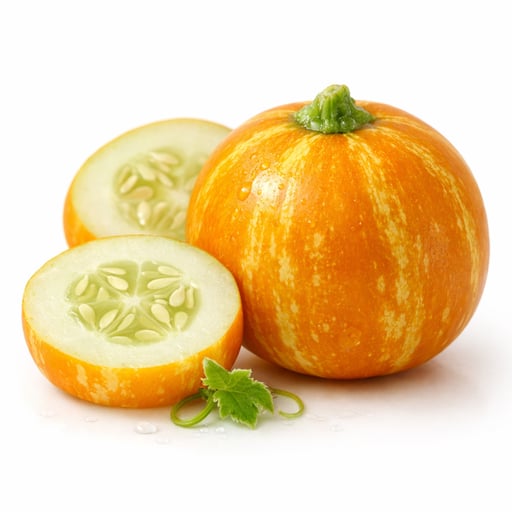
Cucumber, orange, round
Kakadi
Cucumis sativus
Also known as: Tiyoh, Sosha, Kakdi, Southe kayi, Laar, Sohkhia pyllon
Orange round cucumber is a mild-flavored vegetable with crisp flesh and a slightly citrusy aroma, used fresh in salads and snacks.
Nutrition per 100g
Nutrient Breakdown
Key Nutrients(14)
% DV = % Daily Value (adult RDA, ICMR 2020). Values per 100g edible portion.
Use Cucumber, orange, round in meal plans
17,000+ foods with real-time nutrient tracking, AI generation, and WhatsApp sharing.
Start FreeFree plan · No credit card
Common questions about Cucumber, orange, round
How many calories are in 1 katori cooked sabzi of Cucumber, orange, round?
1 katori cooked sabzi (150 g) of Cucumber, orange, round has about 29 kcal, based on 20 kcal per 100 g.
How much protein is in Cucumber, orange, round?
Cucumber, orange, round provides about 1 g of protein per 100 g.
How much sugar does Cucumber, orange, round contain?
Cucumber, orange, round has about 0.2 g of total sugars per 100 g.
How is the orange round cucumber typically used in cooking?
It is usually eaten raw, sliced in salads, or as a fresh snack.
Is orange round cucumber suitable for vegan diets?
Yes, it is a plant-based vegetable and suitable for vegan diets.
How should I store orange round cucumbers to keep them fresh?
Store them in the refrigerator's vegetable compartment in a perforated plastic bag for up to a week.
About Cucumber, orange, round
Orange round cucumber is a unique variety of cucumber with a distinctive orange skin and round shape. Popular in some Indian regions, it is typically consumed raw, sliced for salads or eaten as a refreshing snack. This cucumber contains a modest amount of calories and carbohydrates, with almost negligible fat and protein, making it a low-calorie food option.
- The nutritional highlight for this variety is its significant chromium content, providing about 24% of the daily value per 100 grams.
- It contains small amounts of vitamins and minerals essential for a balanced diet, including vitamin A, potassium, and vitamin C.
This cucumber fits well into vegan diets and is usually enjoyed fresh. It requires no cooking and has no common allergens, making it suitable for diverse dietary needs.
Values per 100g edible portion.
Nutrition data is for reference only. Values may vary by preparation method, brand, and region. Full disclaimer
Similar foods
Browse all →
Cucumber, green, elongate
Kheera, Kachumbar
Cucumber, green, short
Kheera, Kachumbar
Pumpkin, orange, round
Kaddu
Pumpkin, green, cylindrical
Kaddu
Bitter gourd, jagged, smooth ridges, elongate
Karela
Small kovai
Konduri, Kowai
Big kovai
Konduri, Kowai
Bitter gourd, jagged, teeth ridges, elongate
Karela